
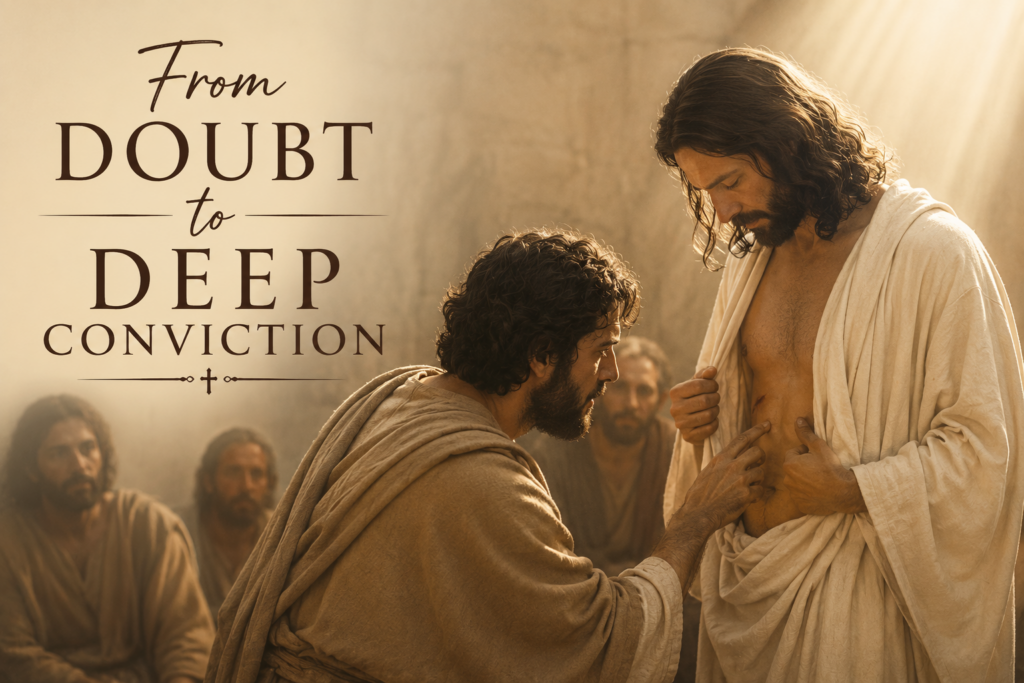
We have all seen the headlines: prominent leaders, influential songwriters, and seasoned pastors walking away from the faith they once championed. These stories serve as a sobering reminder that neither our titles, our years in the pews, nor our impact in ministry shield us from the waves of uncertainty.
Doubt is not just asking questions; it is a divided mind—a state of wavering between faith and unbelief. But while doubt can feel like a spiritual dead end, the story of the disciple Thomas proves it can actually be the doorway to a more resilient faith.
In this study, we investigate the life of “Doubting Thomas” to discover how Jesus meets us in our hesitation. We will explore the vital difference between a struggling mind and a closed heart, and how the Saviour’s response to our deepest questions can move us from doubt to deep conviction.
The Difference of Doubt and Unbelief
Doubt Unbelief
A struggle to believe A refusal to believe
A divided mind A closed heart
A foot in two boats A settled rejection of truth
Example: The Disciples Example: The Pharisees
DOUBTS MAY ARISE.
Scripture is brutally honest. It rejects the fairytale narrative of a perfect life, instead, revealing the raw reality of human frailty. Because we live in a broken world, doubt is not an “if,” but a “when.” Even the spiritual giants of the Bible—from Abraham to John the Baptist—faced crisis moments where their faith collided with their circumstances.
Thomas was no different. He was not a professional skeptic; he was a man of fierce passion and high expectations. He was the one ready to die with Jesus (John 11:16) and eager to follow Him anywhere (John 14:5). But when the crucifixion shattered his expectations, his faith fell apart.
Like Thomas, most people do not just wake up one day and decide to doubt. Doubt is usually sparked by a trigger point—a moment where reality and belief no longer seem to align.
• Intellectual & Theological: Wrestling with science, biblical contradictions, or the nature of Hell.
• Social & Relational: Navigating complex issues of justice, gender, or exposure to diverse perspectives.
• Pain & Trauma: The “Church hurt” caused by toxic leadership, or the silence of God during a personal tragedy.
• Personal Crisis or Suffering: As the Filipino phrase “Natutulog ba ang Diyos?” asks: Is God sleeping?
DOUBTS CAN EITHER BUILD OR BREAK OUR FAITH.
Doubt is a direction, not a destination. It can either purify your faith or harden into a rejection of God. Thomas, whose name means “The Twin,” perfectly represents this divided mind—caught between a desireto believe and a demand for proof.
• Doubt: A “divided mind” struggling to believe.
• Disbelief: A deliberate refusal to believe despite evidence.
• Apostasy: The intentional abandonment of faith.
Thomas saved his faith through these actions:
• Reject Isolation: Grief often drives us into solitude, but isolation only magnifies confusion. Stay connected to your community.
• Stay in the Room: Despite his scepticism, Thomas was still there eight days later. Do not walk away just because you do not have immediate answers.
• Guard Your Inputs: Be discerning about the voices you listen to. Faith is built by God’s Word, while doubt is often fuelled by cynical outside influences.
• Be Brutally Honest: God is not intimidated by your questions. Bring your “unanswered” concerns to Him in prayer rather than letting them rot into suspicion.
Your faith is not diminished by the questions you seek to answer, but by a heart that drifts away from the fellowship of the Holy Spirit and His Church. Will you allow your uncertainty to lead you deeper into the Truth of God’s Word, or will you let it become a foothold that pulls you away from the high calling of Christ?
CHRIST MEETS OUR DOUBTS.
Thomas demanded proof; Jesus responded with His presence. When Jesus walked through those locked doors, He did not offer a rebuke—He offered Himself. His intervention was personal, direct, and incredibly gentle. By inviting Thomas to touch His wounds, Jesus met the specific needs of a struggling heart.
The result: Thomas moved instantly from sceptical hesitation to the ultimate confession of faith: “My Lord and my God!” (v.28) This deep conviction transformed a doubter into a missionary who, according to tradition, carried the Gospel all the way to India.
If Jesus met Thomas with peace, we must do the same for the “Thomases” in our families and churches. When a loved one wavers, follow this blueprint for restoration:
• Pray & Stay Calm: Do not let their questions panic you. Trust God’s timing.
• Stay Present: Do not isolate them. Keep them in your life and community.
• Set Boundaries: Respect their space while staying a consistent witness.
• Be the Example: Show them the fruit of a lived-out faith.
• Never Lose Hope: Whether it takes eight days or eight years, Jesus can reach through any locked door.
Thomas’s journey proves that honest doubt, when met by Christ, ends in worship. God is not finished with the person who questions; He is simply preparing them for a deeper conviction.
 Ponder: Thomas’s name meaning “The Twin” reminds us that we all have a divided nature; will you feed the part of you that seeks the Saviour or the part that demands control?
 Practical Application: When you feel the urge to isolate due to doubt or pain, make a conscious choice to attend your small group, care group or church service. Staying “in the room” with other believers keeps the door open for Jesus to meet you.
 Prayer: Lord, grant me the courage to bring my honest questions to You rather than hiding them in isolation. Help me to believe that You are big enough for my doubts and faithful enough to restore my heart. Amen!